| |  | | | | Un Français Libre parmi 63708
| | 
Cliquez !
| Savielly Tartakower alias Georges Cartier | |
Naissance : 9 février 1887 - Rostov-sur-le-Don, Russie
Activité antérieure : liberal / cadre
Nationalité : Polonais
Engagement dans la France Libre : Londres en juillet 1940
Affectation principale : Terre - Londres / affectation spéciale
Grade atteint pendant la guerre et spécialité : lieutenant
Décès à 68 ans - 4 février 1956 - Paris
Dossier administratif de résistant : GR 16 P 562515
Dans la liste d'Henri Ecochard V40 : ligne 48942 |
Contribuez à son livre ouvert !Ouvert à tous pour exprimer vos sentiments, évoquer vos souvenirs, préciser son parcours, sa vie, poser des questions, citer des livres, des articles, des sites, déposer des documents, photographies, ... | | |
Savielly Tartakower alias Georges Cartier - son Livre ouvert !
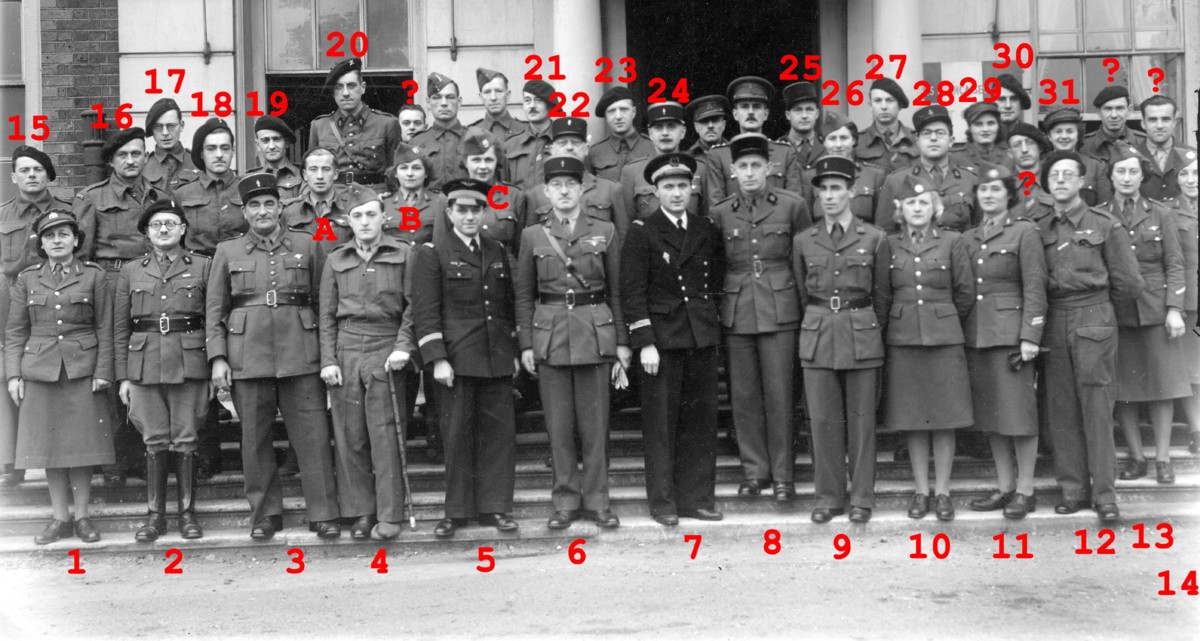
Deuxième Photo « QG France Libre Officiers » Revue de la Fondation de la France Libre juin 2022 
" Au second rang, en haut, de gauche à droite : le capitaine René de Lajudie, alias La Joncière, le sous-lieutenant Tartakover, alias Cartier, le pharmacien-lieutenant Jean Fustec, un sous-lieutenant d’infanterie coloniale non identifié et un aumônier non identifié. Au premier rang, en bas, de gauche à droite : un capitaine des FAFL non identifié, le capitaine Georges Tilgé, le médecin-lieutenant Robet, alias Kerguélen, et un lieutenant de vaisseau des FNFL non identifié." 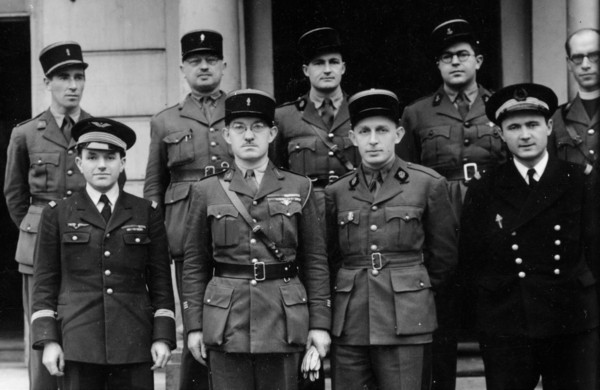
Jacques Ghémard le jeudi 03 novembre 2022 - Demander un contact La page d'origine de cette contribution Recherche sur cette contribution | |
|
22 : le sous-lieutenant Savielly Tartakover, alias Georges Cartier : né le 9 février 1887 à Rostov-sur-le-Don, en Russie, de nationalité polonaise, naturalisé Français le 16 décembre 1945, décédé le 4 février 1956. Légionnaire, il rallie l’Angleterre depuis le Maroc à bord d’un navire britannique. Engagé le 18 juillet 1940 à Londres. Affectations successives : FTGB, Dépôt central des FFL (20 juillet 1940-26 octobre 1941), camp d’instruction d’Old Dean à Camberley (27 octobre 1941-27 février 1942), QG de Londres à Dolphin Square comme officier traducteur (allemand, russe, anglais, français), service du chiffre en ambassade (28 février 1942-18 juin 1943), FTGB (19 juin 1943-7 juillet 1945). Joueur d’échecs international, il participera à plusieurs tournois interalliés d’échecs pendant la guerre.
Revue de la Fondation de la France Libre juin 2022 
Jacques Ghémard le jeudi 03 novembre 2022 - Demander un contact Recherche sur cette contribution | |
|
Maxime Chauvet
Né le 23 mars 1907 - Paris, 75056, Paris, Ile-de-France, France
Décédé vers juillet 1997 - Cuernavaca, Mexique, à l'âge d'environ 90 ans
"... Among those taking refuge were a number of strong chess players who happily engaged in whatever domestic chess action there was, including, as time went on, organised matches against teams of British servicemen. Foremost among these refugee chessers was the already famous Dr Savielly Tartakower - he had been decorated in the First War (in which, incidentally his brother was killed) - albeit he was now known as Georges Cartier. It was said that his real name was difficult to pronounce.
One easier to say may have been that of Maxime Chauvet, mentioned in our earlier posts. Lieutenant Chauvet was a talented player (although by no means as strong as "Tarta") who briefly charmed the domestic chess scene, particularly in London. He appears to have arrived in 1941 serving in an Intelligence Corps with the Free French (the Bureau Central de Renseignements et d'Action) before he was called away in the summer of 1943. Here he is caught on camera, in uniform, at the Sidcup Congress in August 1942 in which he came 4th. ..." 
Laurent Laloup le mercredi 05 février 2020 - Demander un contact La page d'origine de cette contribution Recherche sur cette contribution | |
|
Registres de nationalité ouverts par les Forces françaises libres à Londres
TARTAKOWER, Savielly
Qualité : sous-lieutenant d'infanterie de réserve. Naissance : 22 février 1887-09 février 1887, Rostoff-sur-le-Don, Russie. Résidence : lieu non indiqué. Type d'acte : acquisition de la nationalité française par naturalisation. Date de déclaration : 10 juillet 1941. Date de récepissé : 21 juillet 1941. Remarque : né le 9 février 1887 de l'ancien calendrier [c.-à-d. le calendrier julien] - engagé sous le nom de Georges CARTIER. Laurent Laloup le lundi 30 septembre 2019 - Demander un contact Recherche sur cette contribution | |
|
"....Final years
After a short stay in Argentina he decided to return to Europe. He arrived in France shortly before its collapse in 1940. Under a false name Cartier he joined the forces of general Charles de Gaulle.
After World War II and the communist take-over of power in Poland, Tartakower became a French citizen. He played in the first Interzonal tournament at Saltsjöbaden 1948, but did not qualify for the Candidates tournament. He represented France at the 1950 Chess Olympiad. FIDE instituted the title of International Grandmaster in 1950; Tartakower was in the first group of players to receive that title. In 1953, he won French Chess Championship in Paris.[4]
He died on February 4, 1956, in Paris. ..."
en.wikipedia.org Laurent Laloup le lundi 20 octobre 2008 - Demander un contact Recherche sur cette contribution | |
|
"Tartakower, Saviely
« Chessopedia homeLast updated on Fri, 08/10/2007 at 7:11am.
Saviely Tartakower (1887-1956) was a Grandmaster from France (1950) who played for Poland in six consecutive Olympiads although he never lived there nor could speak the language (he could speak Russian, German, French, and English, and knew Latin and Greek). He once lost five games in a row and was asked why. He replied, "I had a toothache during the first game. In the second game I had a headache. In the third game it was an attack of rheumatism. In the fourth game, I wasn't feeling well. And in the fifth game? Well, must one have to win every game?" He received a Doctor of Law degree in 1909. During World War I he was a Lieutenant in the Austrian army and was shot in the stomach. During World War II he changed his name and was a Lieutenant (Lt. Georges Cartier) in the Free French Army, serving under de Gaulle. In 1929 he gave the first simultaneous chess exhibition on an airplane."
www.chess.com Laurent Laloup le lundi 20 octobre 2008 - Demander un contact Recherche sur cette contribution | |
|
" Arnold Denker reminisces (The Bobby Fischer I Knew and Other Stories) that right then and there Tartakower proceeded to take up a collection for Alekhine, who lived in Portugal with little money. If this is true, one can imagine that it made quite an impression in London in 1946, because Tartakower, to put it cynically and gruesomely, was a man who had a right to speak. When he was twelve years old, both his parents had been murdered in a pogrom in Rostov-on-Don. Much later, when World War II broke out, Tartakower managed at a ripe age to flee from Paris to London, where he joined the army of DeGaulle's Free French. Tartakower could plead for Alekhine without anyone thinking that he had some sympathy for collaboration with the Germans. He could afford to forgive Alekhine."
www.chesscafe.com Laurent Laloup le lundi 20 octobre 2008 - Demander un contact Recherche sur cette contribution | |
|
Xavier Tartakover ou Lt Cartier dans la France libre www.chesshistory.com
" 5140. Tartakower/Cartier (C.N. 4331)
Further to G.H. Diggle’s reference to Savielly Tartakower in C.N. 4331, Hassan Roger Sadeghi (Lausanne, Switzerland) asks if more information is available about Tartakower’s service in the Fighting French Forces during the Second World War under the pseudonym ‘Cartier’.
We offer some notes, beginning with a paragraph by Harry Golombek on page iii of his Translator’s Foreword to the second volume of Tartakower’s Best Games:
‘It might perhaps surprise those who do not know him that at the age of 53 the learned doctor was actively engaged in the battle against Hitler and that, after having been decorated for gallantry in the First World War whilst fighting for Austria, he should now have been just as hotly and bravely engaged on what might be termed the other side. But he has always regulated his behaviour on strict principles of right and wrong. Nothing will ever deter him from embarking on a course which he thinks to be his duty.
Coming through the war unscathed, he resumed his chess activities with undiminished vigour.’
In that source, as well as on page 67 of Chess Treasury of the Air by Terence Tiller (Harmondsworth, 1966), Golombek related his wartime meeting with Tartakower in England. The following appeared in the Tiller book:
‘In 1941 I was stationed in an artillery unit in Northern Ireland, and my service there was relieved by a weekend trip to Nottingham where I was due to play on top board for the British against the Allied Forces. I anticipated an easy victory, as my opponent was an unknown Lieutenant Cartier of the Free French Army. I had the delightful disappointment of discovering that le lieutenant Cartier was no less a person than my old friend Dr Tartakower. When France fell, he had made his way to England via Oran and a British battleship; and there he was, looking just as quizzical as ever, incongruously attired in British battle-dress. Though by now approaching his middle fifties, he was as gallant and determined as ever in his fight for what he believed to be right.’
The chess match was played at the Borough Club, Nottingham on 15 November 1941, as reported on pages 305-306 of the December 1941 BCM, and the score of the game between ‘2nd/Lt. G. Cartier’ and ‘Bdr H. Golombek’ was supplied. The BCM wrote:
‘It is divulging no secret to say that 2nd/Lt. “G. Cartier” is the pseudonym of one who is universally loved and admired wherever chess is played.’
In all, the BCM published about a dozen games by Lieutenant Cartier during the War. The match described by G.H. Diggle took place in London on 22 April 1944 and was reported on pages 107-109 of the May 1944 BCM. His opponent was G. Wood. The pseudonym ‘Cartier’ was no secret; for instance, page 268 of the December 1942 BCM referred to ‘Lt. G. Cartier of the Fighting French, better known in the chess world as Dr Tartakower, the great international’.
We still seek substantiation of the claim that Tartakower was several times ‘dropped by parachute behind enemy lines on secret missions’ (see page 331 of Kings, Commoners and Knaves). More generally, what else is known about Tartakower’s activities during the Second World War?" 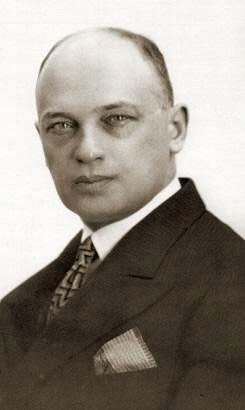
Laurent Laloup le lundi 20 octobre 2008 - Demander un contact Recherche sur cette contribution | |
Dernière mise à jour le jeudi 03 novembre 2022 Vous pouvez à tout moment obtenir la rectification des données, vous concernant, inscrites dans cette base qui est déclarée sous le n° 1137942 auprès de la Commission Nationale Informatique et Liberté  |
| |
fiche.php PHPisé et MySQLisé par Jacques Ghémard le 20 6 2025 Hébergé par Nuxit Temps entre début et fin du script : 0.53 s 8 requêtes 
|
|